
The Great Remote Desktop Dilemma
I know the pandemic is over GENIUS !
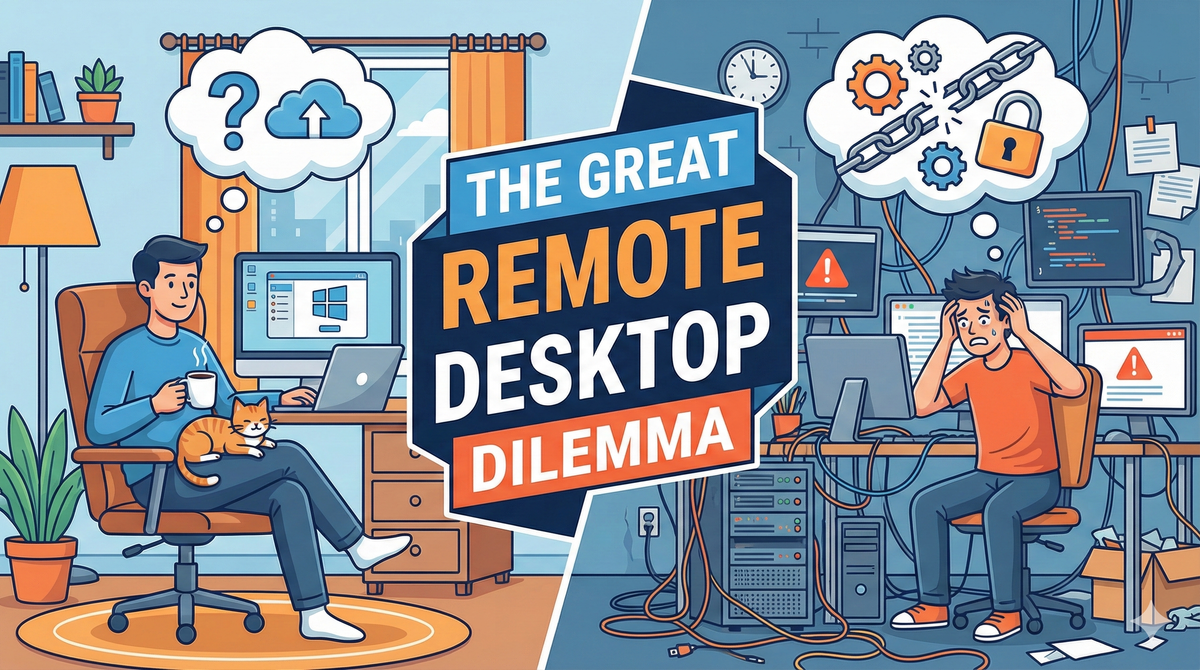
Remote desktop in 2026 is dominated by the usual suspects—TeamViewer, AnyDesk, Chrome Remote Desktop—but some of the best tools are the weirdos lurking just off‑mainstream: Reemo, Sunshine + Moonlight + ZeroTier, and DWService. These three quietly cover almost every use case a developer or gamer could want, often with better privacy and streaming performance than the big names.
Why these “underdogs” matter
The mainstream tools are optimized for support desks and corporate IT; these are optimized for ownership, latency, and flexibility.
- Reemo: high‑fidelity, browser‑based remote desktop with 4K/60, color‑accurate streaming, multi‑monitor and serious enterprise features, but free for individuals.
- Sunshine + Moonlight + ZeroTier: fully self‑hosted, low‑latency streaming stack that treats your PC like a private GeForce Now, over an encrypted virtual LAN.
- DWService: incredibly simple, browser‑only client—install agent once, control from any browser, ideal for “I just need in” moments.
For developers and gamers, that combo means: near‑native input latency for games and 3D tools, secure access to dev machines without exposing RDP/SSH to the internet, and ways to reach machines from locked‑down client devices where you can’t install heavy software.
High‑level setup vibe (host + client): install RustDesk on both machines, exchange ID and password, connect; optionally point both clients at your own RustDesk server instead of the public one for full control.
How they compare to mainstream tools
Here’s the landscape in plain terms.
| Tool | Hosting model | Ease of client | Privacy/Control | Streaming Performance | Good For.. |
|---|---|---|---|---|---|
| Reemo | SaaS (cloud, no self‑host) | High | Data via Reemo’s infra; strong enterprise controls, free individual tier. | 4K/60, 4:4:4, multi‑monitor, low latency. | Creative work, remote workstation, mixed OS. |
| Sunshine + Moonlight + Zerotier | Fully self‑hosted | Medium | You own server + overlay network; end‑to‑end encryption via ZeroTier. | Excellent; near‑native latency for games. | Gaming, dev workstation, homelab. |
| DWService | SaaS (agent + web) | High | Agent phones home to DWService; free, limited self‑control | “Good enough”; utility‑grade, not 4K gamer. | Support, quick access, low‑spec clients. |
| Chrome Remote Desktop | SaaS (Google) | High | Tied to Google account + infra. | OK for general use, not tuned for pro streaming. | Casual remote work, friends/family. |
| TeamViewer / AnyDesk | SaaS + relay | High | Strong encryption but proprietary; vendor controls infra. | Good general streaming; not gaming‑focused. | Support, SMB/enterprise IT. |
| RustDesk | Self‑host or public | Medium | Can self‑host ID/relay; strong privacy if you do. | Solid; more “support tool” than game streamer. | Power users, privacy‑sensitive remote help. |
For a dev/gamer, Reemo and Sunshine+Moonlight+ZeroTier usually beat the mainstream on performance and control, while DWService beats them on “I’m on a random device with only a browser and terrible permissions.”
Reemo: high‑end workstation in a browser
Reemo is what you’d get if someone fused Teradici‑style remote graphics with a web app and then quietly made it free for solo users.
Why Reemo is interesting
- Free for individuals: personal users can use Reemo without paying; teams pay for multi‑user, project and enterprise features.
- Streaming quality: up to 4K at 60 fps, 4:4:4 chroma, multi‑monitor, tuned for color‑critical and latency‑sensitive workflows.
- Device forwarding: webcam, mic, USB/tablet/redirection where supported, making it viable for creative suites and calls.
- Enterprise bits: SSO (SAML/OIDC), MFA, LDAP/SCIM, role‑based access, audit logs, scheduled access, etc.
Compared to TeamViewer/AnyDesk: better for high‑resolution multi‑monitor creative or dev work, especially from locked‑down client devices where a browser is all you get.
Use Case:
Developer:
- Park a high‑core‑count Linux/Windows box at home or in the office and use Reemo to turn your light laptop or Chromebook into a portal to that machine.
- Run heavy IDEs (VS Code, JetBrains), Docker/K8s clusters, backend services, and databases on the remote box while editing, debugging, and testing as if it were local thanks to 4K/60, multi‑monitor, and sharp 4:4:4 output.
- Spin up Windows and Linux VMs or dual‑boot setups on a single powerful host and access them all from Reemo, which is ideal when you need to hop between environments for backend, frontend, and infra work.
- The browser client means you can use this dev rig from almost any machine (even a locked‑down corporate laptop) without installing a fat client.
Gamer:
- Use Reemo to reach your gaming PC when you’re away: start downloads, update launchers (Steam, EA, Ubisoft), tweak settings, and queue installs so everything’s ready when you’re home.
- For slower or less twitchy games, the 4K/60 streaming with good color and multi‑monitor support makes casual play from a browser very workable.
- Manage game servers, mod tools, and recording/streaming software (OBS, clip managers) on your main rig remotely, while you’re on a lighter device.
Sunshine + Moonlight + ZeroTier: your own private cloud gaming
Sunshine (server) + Moonlight (client) is essentially open‑source NVIDIA GameStream on steroids; add ZeroTier to avoid port‑forwarding and to encrypt everything in a virtual LAN.
Why this stack matters
- Latency: optimized for game streaming; hardware encoding plus efficient protocols make it feel close to local over good links.
- Self‑hosted: Sunshine is your server, Moonlight your viewer; ZeroTier makes them think they’re on the same LAN from anywhere.
- Cost: everything is free and open source; your only real cost is time and electricity.
Compared to mainstream: where TeamViewer/CRD aim for “usable desktop,” Sunshine+Moonlight aim for “play actual games and edit video without rage.”
Use Case:
Developer:
Remote into your Linux dev box with full desktop, run IDEs, Docker, K8s dashboards, and even test GPU workloads from a laptop or tablet with very smooth input.
Gamer:
Your own cloud gaming platform—play from the sofa, hotel, or another country, with ZeroTier pretending it’s all one LAN.
DWService: “I only have a browser”
DWService is the “I’m on a locked‑down machine with no admin rights but I still need to reach my box” tool. You install an agent on the host once; after that, everything is controlled via the DWService website.
Why DWService is important
- Zero client install: the viewer runs entirely in the browser; only the remote machine needs the agent.
- Free and cross‑platform: supports Windows, Linux, macOS, and even small boards like Raspberry Pi.
- Tools beyond screen: file manager, terminal, processes, logs—great for admin work and emergency fixes.
Streaming quality is more “utility remote control” than “buttery 4K,” but for dev tasks and troubleshooting, that’s often enough.
Use Case:
Developer:
Do quick fixes on a server (edit configs, restart services, tail logs) from a random borrowed laptop.
Gamer:
mostly secondary—manage downloads, restart the game server, or fix config files without streaming gameplay.
TL;DR
- Reemo = remote workstation in a browser.
- Sunshine + Moonlight + ZeroTier = self‑hosted cloud PC / cloud gaming.
- DWService = emergency Swiss Army knife from any browser.